
Building Brand Authority in Search
An Interview with the Expert Jes Scholz
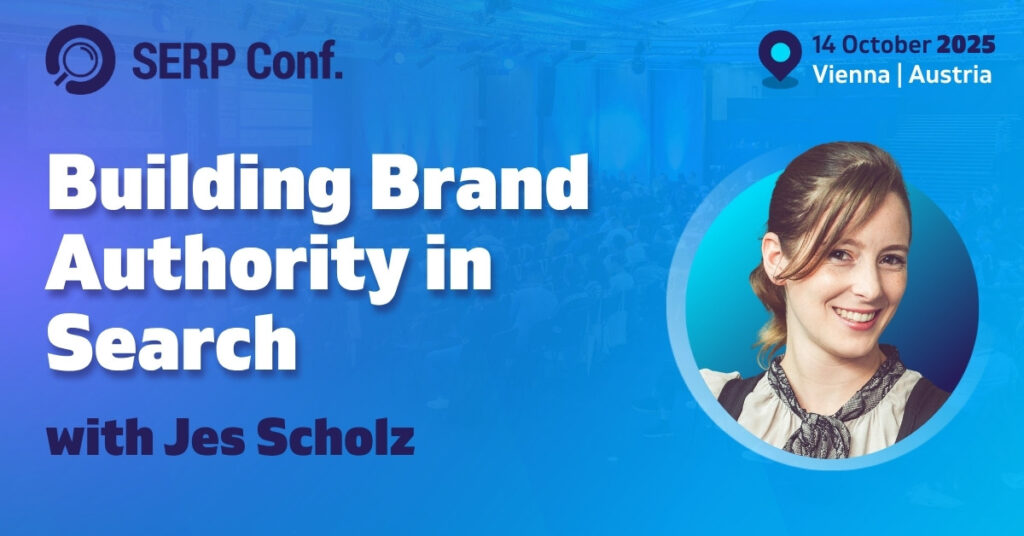
About Jes Scholz
Jes Scholz is an international marketing consultant and SEO strategist who advises enterprise brands on digital growth. Her expertise spans digital brand management, content distribution, and data-driven marketing. She’s known for her work on entity-based SEO, AI in search, and technical optimization strategies.
Even though Jes won’t be part of the speaker lineup this year in Vienna, she strongly believe in the mission and ideas behind SERP Conf.
Dive into her interview – it’s packed with insights on the future of SEO, branding, and search.
What strategies are most effective for brands trying to build authority in a certain topic, especially when we talk about highly competitive niches?
Obviously publishing content around that topic. But regular coverage alone is not enough. It’s important to add to the conversation. This can be offering new information, a deep analysis or just a fresh take on an issue (someone who is qualified to have an opinion!). And don’t forget that it’s not only about text alone. Video (vertical short and horizontal longer form) as well as audio (such as podcasts) and images are becoming increasingly important for brand visibility.
Based on your experience and work so far, how are successful brands leveraging entity-based search to establish stronger digital identities?
Successful brands are those that learn to walk, before they try to sprint. Start with optimising your own brand entity. Simple things like measuring the impact of standardising use of your brand name across all digital mentions. And then building new, meaningful mentions. Or how to brandsplain an entity and its relationships using graph based structured data. Once you learn how to do it (and measure it!) for something you have full control over. It’s much easier to then apply that knowledge to other important entities.
How should brands approach SEO today? What is the most important thing that has changed compared with previous years?
We are seeing a recession in sessions, but a renaissance of branding. Successful brands will embrace this. Understanding that exposure through organic visibility builds brand preference, which will eventually result in conversion.
But we are now more clearly recognising, for it has always been the case, that this process is not perfectly trackable. The impact of SEO can not be measured via google / organic traffic alone. It is also found in direct when after reading your content for months, a user decides to come to convert. It is found in social, as many of your YouTube views or social engagement will be due to that post being visible on Google surfaces. It can be found in email, as the subscriber list has built up over time due to articles winning organic visits.
When you stop treating SEO as a performance channel, and embrace it as a branding channel, the tactics you prioritise will shift for the better.
What common technical SEO issues still plague even sophisticated websites, and what are the most efficient solutions?
The GSC exclusions ‘Discovered, not indexed’ and ‘Crawled, not indexed’. Many SEOs focus too much on ranking, forgetting that your content can not complete until it is crawled and indexed.
Every SEO relevant page that is not indexed, is brand visibility lost. And if you have pages in your sitemap showing these exclusions that are not SEO relevant, well, then you have website architecture issues.
The best solution, once you have dependable sitemaps, is using other indexing hints. Things like submitting RSS feeds of latest content to GSC & BWT. Using Indexing APIs. Or leveraging internal linking structures.
How will AI-driven search experiences change user expectations compared to traditional keyword-based search?
I see users expecting a faster path to a resolution. Because if search is not more efficient with AI, there is no motivation to switch. The fact that so many people are now using ChatGPT or Gemini powered surfaces, shows that AI can deliver a superior user experience. And SEO content must be better than what AI surfaces can offer to survive.
What this means for brands is that you need to provide an exceptionally valuable answer directly. Not bury the lede.
Think, for example, of recipe websites. For years now, the actual value of the recipe was 7 scrolls down the page beneath a story about how grandma made apple pie.
Traditional search had no choice but to rank based on URLs, so this approach did work for rankings, even though it frustrated searches.
Now, it won’t.
Now users can get recipes directly on AI surfaces. So if you are currently earning organic clicks, or have strong direct traffic, to maintain these users you must provide a superior user experience. This means, put the recipes at the top and ask yourself what additional value can you offer, beyond what AI can. Such as video explainers, expert advice or advanced nutritional information.
As search engines incorporate more zero-click experiences, what will be the new metrics for measuring search success beyond traffic that you will take into consideration in your work?
I’d say how we measure success is being completely disrupted. No longer is the focus on clicks from keyword rankings on traditional search. But we are moving toward measuring brand visibility across all surfaces (Search, Discover, News, AI chatbots, etc). Now the real challenge is understanding how to measure it.
The simplest answer is add up the impression across all surfaces. But this is fraught with issues. Those impressions need to make an impression on the user! If you are position 0, due to being in an AI Overview citation, but your citation number 9, no real human will ever see your brand. For visibility metrics to be meaningful, rather measure share of voice; taking into account the position of the placement.
As well as share of branded search vs that of your competitors, which Les Binet has shown to be a leading indicator for market share.
These combined are a good baseline to understand if your SEO strategy is having a real impact on brand salience.
Tickets | 3 & 4 NOVEMBER 2026
Tickets for SERP Conf. Vienna
For the first time, SERP Conf. Vienna will take place over two days. The conference will be held on November 3, and the Masterclasses will take place on November 4.
Two professionals – one ticket
Works on every ticket type below – the discount applies at checkout.
Conference Ticket
€749
Final price
€499
2 Conference Tickets for the price of 1
DAY 1
Conference day
DAY 1
Networking Cocktail
DAY 2
Masterclasses
200 seats · general admission
Most popular
Cocktail Bundle
€849
Final price
€599
2 Cocktail Bundles for the price of 1
DAY 1
Conference day
DAY 1
Networking Cocktail
DAY 2
Masterclasses
Only 100 cocktail attendees
Best value
Masterclasses Bundle
€949
Final price
€699
2 Masterclasses Bundles for the price of 1
DAY 1
Conference day
DAY 1
Networking Cocktail
DAY 2
2 Masterclass
Only 20 seats per masterclass
Lock in your Early Bird price before 18 October 2026. After that, every ticket price goes up.